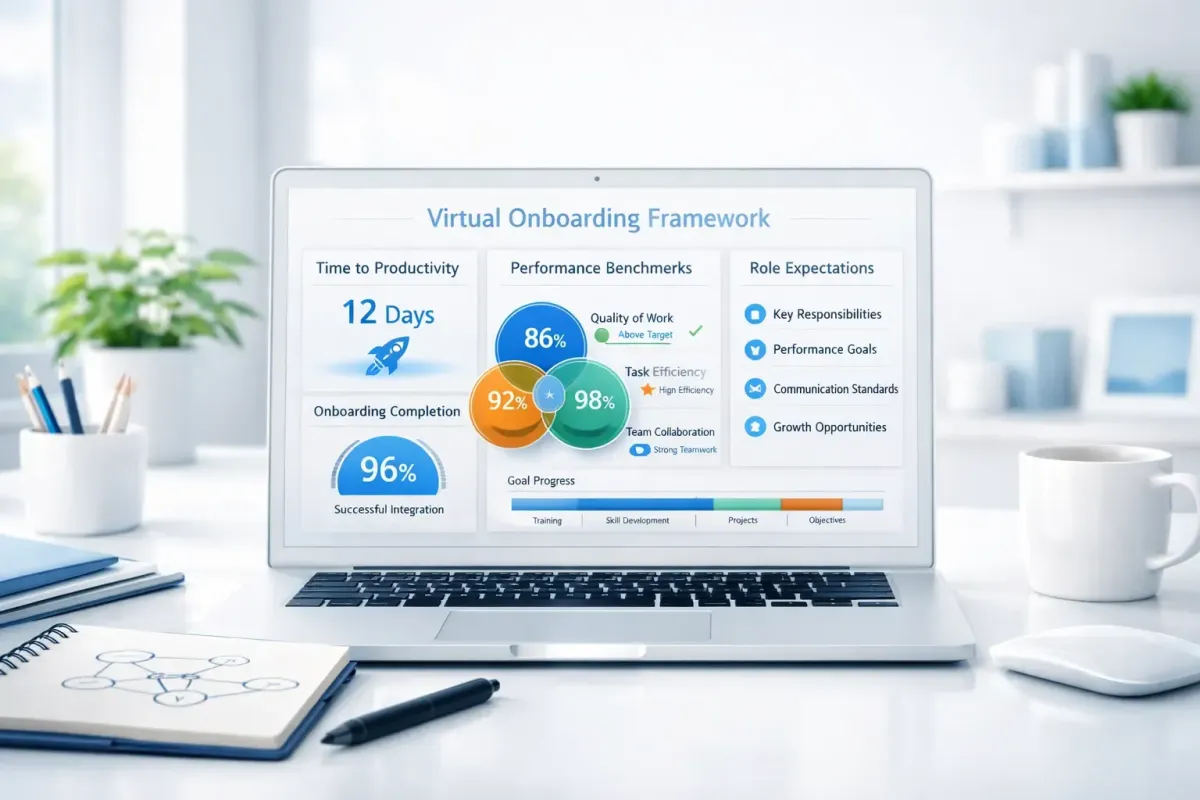
Virtual Onboarding Process: Remote Performance Standards
Virtual onboarding is the process of integrating new employees into a company remotely using digital tools, workflows, and structured communication—without requiring a physical office presence.
For example, a company hiring a remote developer in Turkey can onboard them through virtual onboarding by setting up digital accounts, assigning initial tasks, and introducing communication tools like Slack and Jira—all handled online.
For enterprises scaling within the Middle East, the onboarding phase is the most critical window for risk mitigation.
A fragmented virtual onboarding process leads to "performance drift"—a state where remote hires lack the clarity or infrastructure to meet organizational expectations.
Establishing a high-standard operational layer during this phase is the only way to ensure long-term ROI.
Table of Content
The Step-by-Step Virtual Onboarding Process
2. Digital Workspace Provisioning
3. Infrastructure & Security Audit
4. Cultural & Performance Alignment
Remote Onboarding Best Practices: Ensuring Long-Term Success
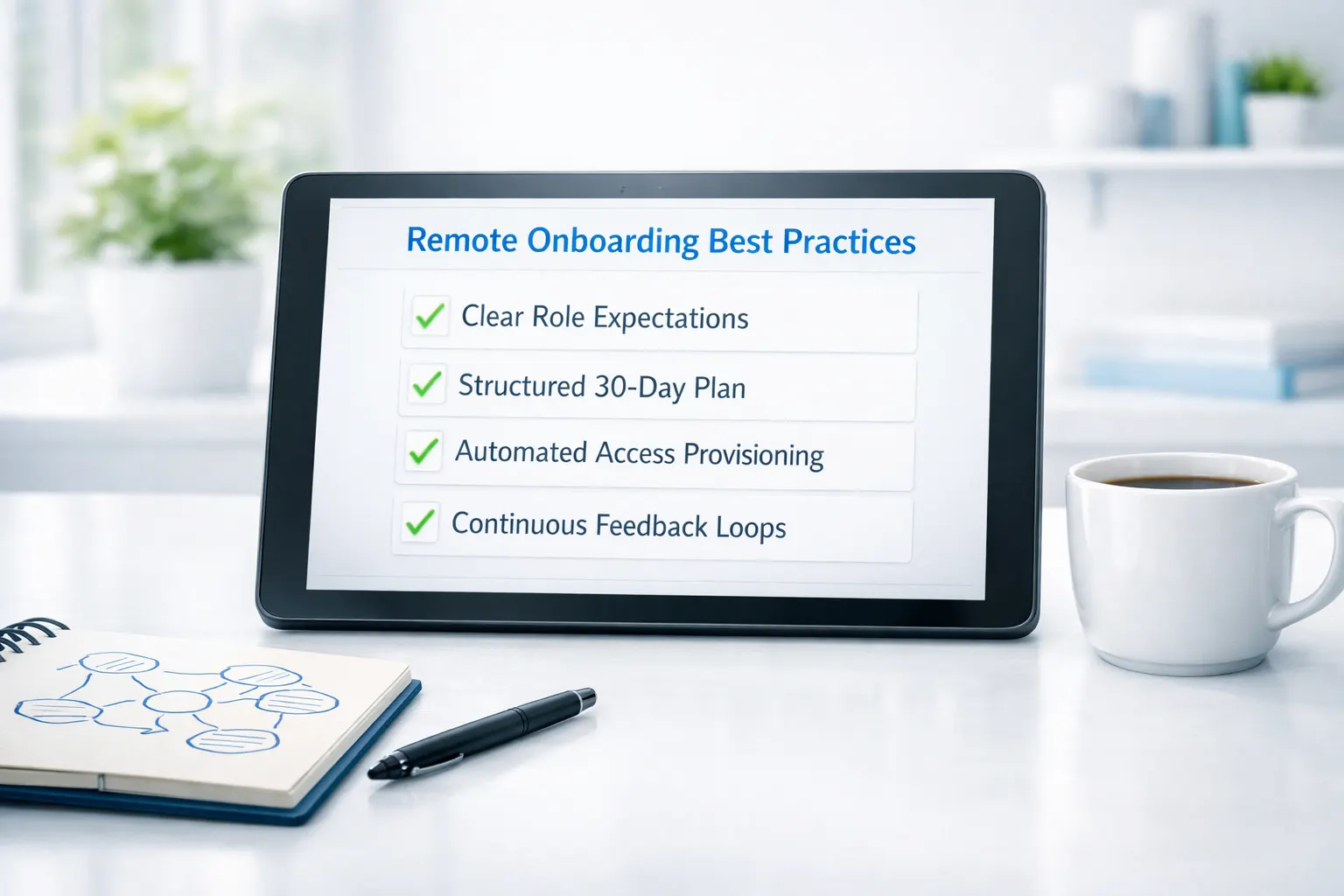
The Remote Onboarding Checklist (Quick Wins)
Establishing Remote Performance Standards (Remotya’s Operational Layer)
Strategic Operational Alignment
Technical and Security Resilience
The 4-Phase Virtual Onboarding Protocol
Why Traditional Onboarding Fails in the Middle East
FAQ: Mastering the Virtual Onboarding Process
The Step-by-Step Virtual Onboarding Process
To successfully onboard remote employees, you need a workflow that mirrors the reliability of an in-person orientation while leveraging the speed of digital tools. Here is how to structure the journey:
1. Pre-Boarding & Compliance
The process begins before the employee's first day. This involves finalizing legal contracts via an Employer of Record (EOR) and ensuring all statutory requirements are met. In the MENA region, this stage is vital to provide the professional with financial and legal security.
2. Digital Workspace Provisioning
Access is productivity. Onboarding remote employees step-by-step must include a dedicated phase for "Access Provisioning."
This means setting up email accounts, VPN access, and project management permissions (Jira, Trello, or Asana) at least 48 hours before the start date.
3. Infrastructure & Security Audit
Unlike local hires, remote professionals rely on their own environment. A professional virtual onboarding process must include a technical audit. This ensures that the hire has the required internet bandwidth, power redundancy (UPS), and a secure, encrypted hardware setup.
4. Cultural & Performance Alignment
The final step is defining "What Success Looks Like." This involves introducing the hire to the team's communication protocols, response time standards, and the 30-60-90 day performance roadmap.
Remote Onboarding Best Practices: Ensuring Long-Term Success
To move from a "basic" setup to a "high-performance" engine, organizations should adopt these best practices:
Prioritize Asynchronous Documentation: Don't rely on meetings for everything. Provide a "Single Source of Truth" (like a Notion or Confluence wiki) where the new hire can find answers without waiting for a manager.
Establish Communication Latency Standards: Define clear expectations for response times. For example, Slack messages should be acknowledged within 2 hours, while emails follow a 24-hour rule.
Use the "Buddy System": Pair every new hire with a veteran team member. This reduces isolation and provides a "safe space" for operational questions.
Focus on Output, Not Presence: Measure the success of your onboarding by the completion of the first "billable task" rather than the number of hours spent in orientation calls.
The Remote Onboarding Checklist (Quick Wins)
If you are looking to audit your current process, ensure you have checked these boxes:
[ ] Legal: Verified EOR compliance and localized contracts.
[ ] IT: VPN, MFA, and Password Manager accounts active.
[ ] Tools: Access granted to Slack, Jira, Figma, or relevant stack.
[ ] Hardware: Personal asset audit completed (Speed/Security).
[ ] Logistics: Backup internet and power redundancy verified.
[ ] Social: Welcome announcement and introductory 1-on-1s scheduled.
Establishing Remote Performance Standards (Remotya’s Operational Layer)
While the checklist gets the employee "online," establishing Performance Standards is what keeps them productive. In distributed environments, we move away from visual management toward Structural Accountability.
Strategic Operational Alignment
The goal of a professional virtual onboarding process is to eliminate "Operational Latency"—the dead time a new hire spends waiting for instructions. At Remotya, we treat onboarding as a "Technical Deployment." This means we synchronize the legal, technical, and cultural layers simultaneously to reduce Time-to-Productivity by up to 60%.
Technical and Security Resilience
In regions like Syria or Lebanon, remote performance is dependent on technical uptime. We don't just "hope" for stability; we audit it. A core standard in our onboarding is verifying "Resilience Kits"—ensuring the professional has the secondary internet nodes and power backups needed to maintain a 99% uptime SLA.
The 4-Phase Virtual Onboarding Protocol
Why Traditional Onboarding Fails in the Middle East
Most global companies try to apply "Silicon Valley" onboarding to the MENA region. This usually leads to high turnover because it ignores the regional "Friction Points."
The Utility Gap: Standard onboarding doesn't check if the employee has a UPS (Uninterruptible Power Supply). When the power goes out, the "onboarding" stops.
The Payment Anxiety: If the onboarding doesn't clearly explain how the employee is legally secured and paid in local currency, the professional stays in a "gig worker" mindset, ready to leave for the next offer.
The Isolation Factor: Remote hires in this region need to feel the "Operational Presence" of the company to build loyalty.
FAQ: Mastering the Virtual Onboarding Process
What is the ideal duration for a virtual onboarding process?
While cultural integration is an ongoing journey, the operational onboarding—including IT setup and compliance—must be completed within 14 days to maximize efficiency.
How do you handle hardware security if the employee uses their own device?
Through Virtual Workspace Hardening. We audit the personal device and install an encrypted, managed layer that separates personal use from corporate data, ensuring 100% compliance with security standards (Managed BYOD).
What is the most common failure in remote onboarding?
"Information Overload" combined with "Access Under-delivery." New hires are often given too much reading material but not enough technical access to actually start their work. Our protocol flips this, prioritizing access and tools first.
How do you measure the success of an onboarding program?
By monitoring the Onboarding SLA. This includes tracking the time from the signed contract to the first completed billable task. Success is defined by a "Time-to-Productivity" of less than 14 days.
Conclusion: The Infrastructure of Excellence
A successful virtual onboarding process is not defined by a welcome email; it is defined by the infrastructure of excellence. By establishing clear performance standards and securing the technical operational layer, firms can turn remote hiring from a high-risk gamble into a predictable growth engine.
The companies that scale fastest in the Middle East are those that realize onboarding is the foundation of their Technical ROI. Ready to professionalize your remote integration?
Deploy Your Next Professional in 14 Days
Eliminate Integration Friction: Don't let your growth be stalled by administrative red tape or infrastructure gaps. Build a compliant, secure, and productive distributed team with Remotya’s high-speed onboarding framework.
[Talk to our Onboarding Specialists] and accelerate your time-to-hire today.