What is an Employer of Record (EOR)? Global Expansion Guide
An Employer of Record (EOR) is a third-party organization that legally employs workers on behalf of another company.
It allows businesses to hire international talent legally and compliantly without the need to set up a local legal entity or branch in a foreign country.
While the employee works for you and follows your internal workflows, the EOR handles all the institutional "back-office" complexities, including payroll, taxes, statutory benefits, and compliance with local labor laws.
Table of Content
How Does an Employer of Record (EOR) Work?
EOR vs. PEO: What is the Difference?
Strategic ROI: Why Use an Employer of Record?
1. Speed-to-Market (The 14-Day Advantage)
2. Cost Efficiency (OpEx vs. CapEx)
Visual Comparison: Expansion Models at a Glance
Utilizing EOR in the Middle East: Navigating Regional Nuance
Regional Compliance and Labor Codes
The Operational Layer: Beyond Payroll
FAQ: Everything You Need to Know About EOR
Does using an EOR affect my intellectual property (IP)?
Can I hire anyone, anywhere with an EOR?
What happens if I want to open my own entity later?
How Does an Employer of Record (EOR) Work?
Understanding the EOR framework is essential for any business looking to scale across borders. The process creates a tripartite relationship between the Client Company (you), the EOR Provider, and the Employee.
The Core Mechanism
When you utilize an EOR, the provider becomes the official employer on paper. They take over the administrative burden, while you retain 100% control over the employee's daily tasks, performance reviews, and strategic direction. This decoupling of "legal employment" from "operational management" is the primary engine behind modern global expansion.
The EOR Responsibilities
A professional EOR partner manages the following administrative lifecycle:
Onboarding: Drafting localized employment contracts that align with regional labor codes.
Payroll: Executing monthly payments in local currencies.
Tax Compliance: Withholding and filing all necessary income and social security taxes.
Benefits Administration: Managing health insurance, pensions, and statutory leave (vacation, sick days, etc.).
EOR vs. PEO: What is the Difference?
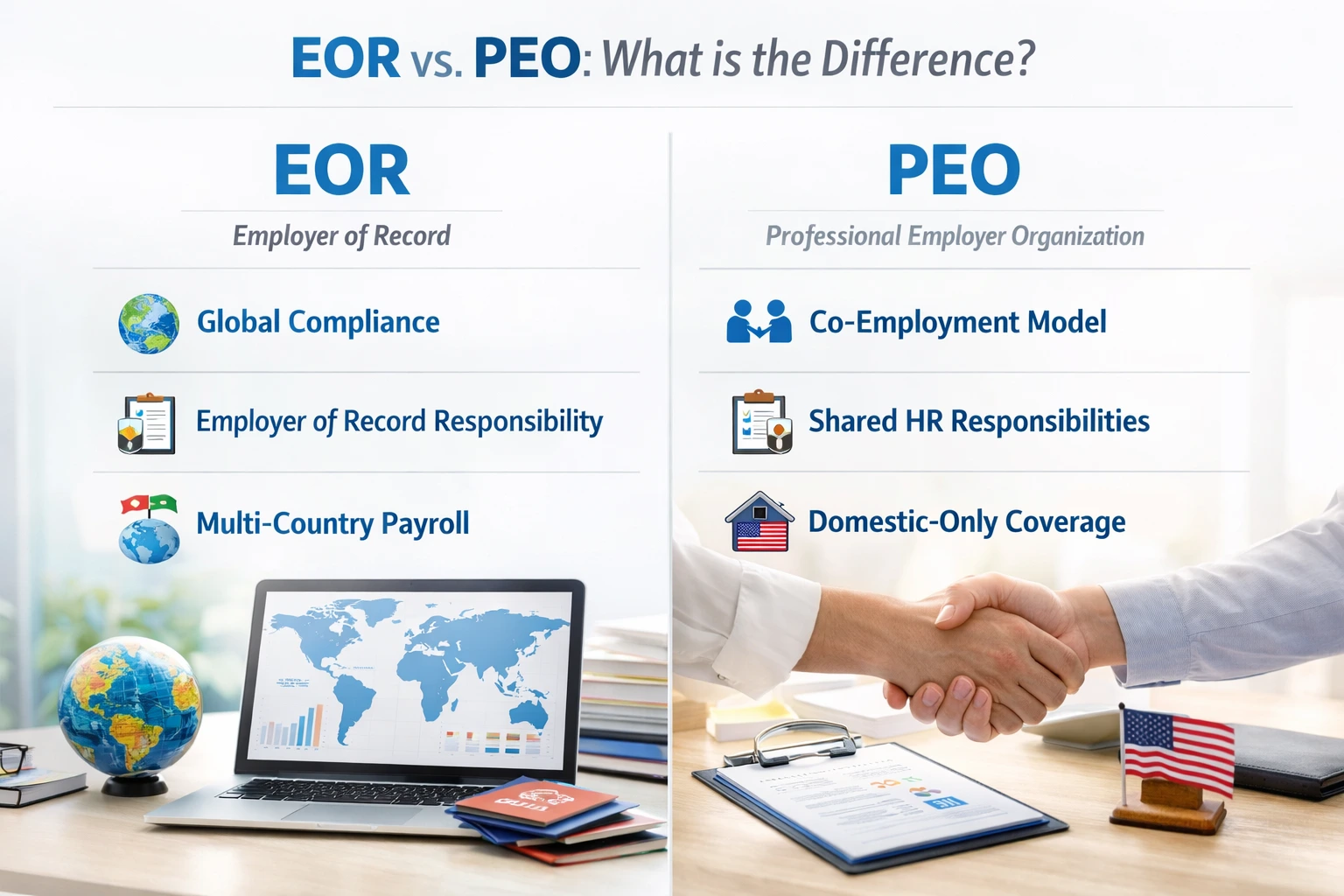
One of the most common questions for firms looking at global hiring is the difference between an Employer of Record (EOR) and a Professional Employer Organization (PEO).
PEO (Co-Employment): Under a PEO model, you share legal responsibility for the employee. Crucially, a PEO requires you to have your own legal entity in the country where the employee is based.
EOR (Full Legal Employment): An EOR does not require you to have a local entity. The EOR provider takes on all legal liabilities. This makes the EOR model the preferred "Entry Point" for companies testing new markets or hiring distributed teams in regions like the Middle East.
Strategic ROI: Why Use an Employer of Record?
Beyond the simple definition, utilizing an EOR provides a high Operational ROI by solving for three major bottlenecks: speed, cost, and risk.
1. Speed-to-Market (The 14-Day Advantage)
Building a legal subsidiary in a new market like Turkey or Egypt can take 6 to 12 months. With an EOR, you can hire and onboard a professional in as little as 14 days. This agility allows enterprises to seize market opportunities before competitors can navigate the local bureaucracy.
2. Cost Efficiency (OpEx vs. CapEx)
Setting up a branch involves massive Capital Expenditure (CapEx)—legal fees, office leases, and local administrative staff. An EOR converts these costs into a predictable, subscription-style Operational Expenditure (OpEx). You only pay for what you use, making it easy to scale up or down based on project needs.
3. Total Risk Mitigation
International labor laws are a minefield. Misclassifying a contractor or failing to pay the correct social security contributions can lead to massive fines.
An EOR acts as a Compliance Shield, absorbing the legal risk and ensuring your expansion remains 100% audit-proof.
Visual Comparison: Expansion Models at a Glance
Utilizing EOR in the Middle East: Navigating Regional Nuance
The Middle East (MENA) represents a high-talent corridor, but its regulatory environment is complex. Utilizing a localized EOR partner is vital for success in markets like Turkey, Lebanon, or Syria.
Regional Compliance and Labor Codes
Each country in the MENA region has distinct requirements for notice periods, severance pay, and social security.
A professional EOR provider ensures that your employment agreements are not just "translated," but "localized" to prevent legal disputes and ensure long-term employee loyalty.
The Operational Layer: Beyond Payroll
In complex markets, a standard EOR is often not enough. At Remotya, we introduce the Operational Layer.
This means we manage the legalities (EOR) while simultaneously ensuring Business Continuity. We monitor the professional’s infrastructure—ensuring they have the security, power redundancy, and connectivity needed to perform at an enterprise level.
FAQ: Everything You Need to Know About EOR
How much does an EOR cost?
Most EOR providers charge a flat monthly fee per employee or a percentage of the payroll. This fee covers all the legal, tax, and administrative work involved in maintaining the employee.
Does using an EOR affect my intellectual property (IP)?
No. A professional EOR agreement includes strict IP transfer clauses. All work products created by the employee are legally assigned to your company, ensuring your proprietary data and innovations remain your assets.
Can I hire anyone, anywhere with an EOR?
Essentially, yes. As long as the EOR provider has a legal presence in the target country, you can hire talent. This allows for "borderless hiring," where you can build a team across multiple time zones under a single management interface.
What happens if I want to open my own entity later?
The EOR model is highly flexible. Many companies start with an EOR to test a market or build a small team. If the headcount grows significantly, they can transition those employees to their own local entity at any time.
Conclusion: De-risking Global Expansion
Understanding what an Employer of Record is is the first step toward a borderless growth strategy. By decoupling talent acquisition from geographic bureaucracy, enterprises can scale with a level of speed and security that was previously impossible.
The EOR model is the backbone of the modern Operational Layer. It allows your firm to focus on innovation and output, while the partner handles the complexity of global employment.
Start Your Global Expansion Today
Scale Without Borders: Don't let legal red tape slow down your vision. Deploy a compliant, high-performance team in the Middle East in two weeks with Remotya’s EOR and Operational framework.
[Book a Compliance Audit] to see how an EOR can accelerate your 2026 growth targets.