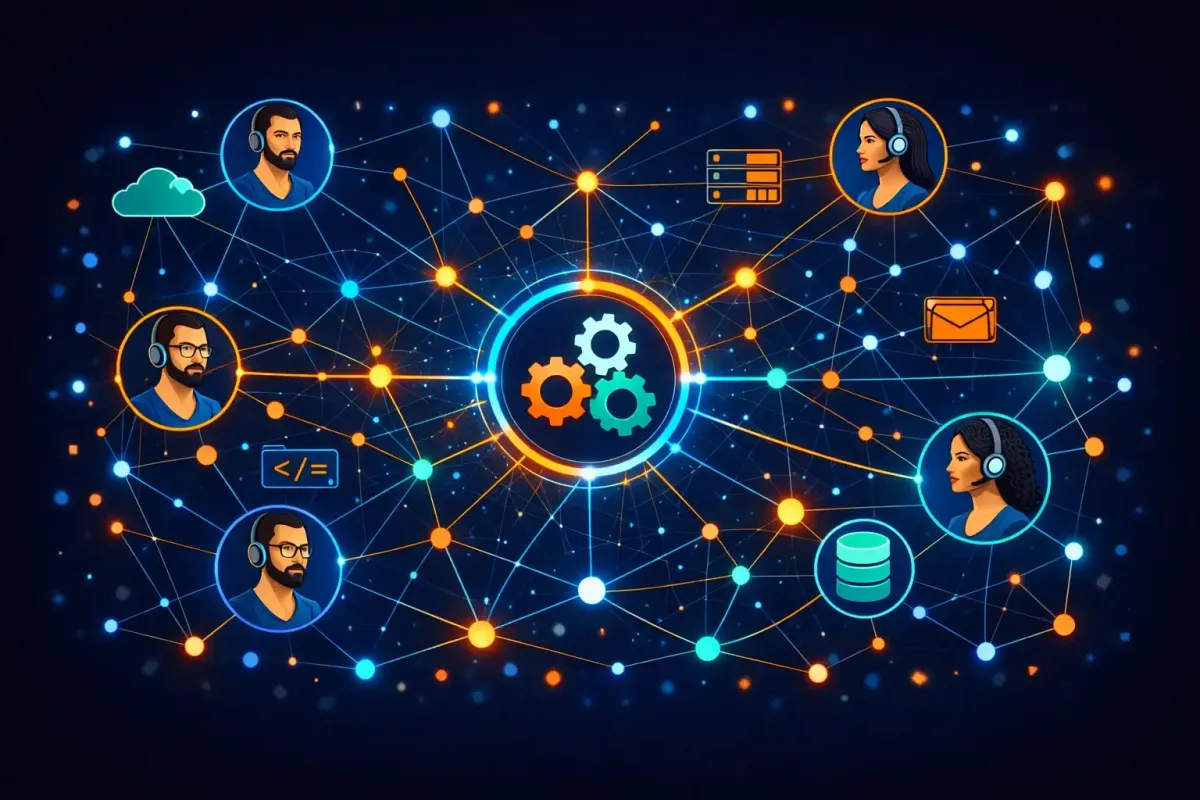
Building Remote Teams with Zero Friction: An Operational Blueprint
Scaling a technical team in 2026 is no longer about geographical proximity; it is about operational architecture.
For many startups and mid-market firms, the transition to a distributed model often leads to increased latency in decision-making and a noticeable drop in technical velocity.
This isn't a failure of talent—it is a failure of the system.
To successfully build remote teams, you must move beyond "remote-friendly" and become remote-first.
This requires a fundamental shift f4rom presence-based management to a structured, frictionless operational engine that treats distance as a non-factor.
Table of Content
Identifying the Root Causes of Operational Friction
Context Switching and "Ping" Fatigue
How to Build Remote Teams Without Friction: The IKEA Effect
Engineering Asynchronous Excellence
Protecting the Engineering "Flow"
Technical Culture and System Fault Tolerance
Abstracting the Physical Layer: The Remotya Managed Layer
Identifying the Root Causes of Operational Friction
In a centralized office, communication happens by accident—over coffee or across desks. In a remote environment, "accidental communication" vanishes, and if it's not replaced by a deliberate system, it creates operational debt.
Before you scale your distributed workforce, you must identify and eliminate the three silent killers of remote productivity:
Synchronous Dependency
If your engineers are waiting for a Zoom meeting to make a decision, your deployment pipeline is effectively stalled. High-growth companies cannot afford to have their CI/CD cycles tied to someone’s calendar.
When decisions require "everyone to be in the room," you create a bottleneck that grows exponentially as you add more team members.
Context Switching and "Ping" Fatigue
Constant notifications for status updates destroy the Deep Work hours required for complex problem-solving. In a remote setup, this "ping culture" is the leading cause of burnout and low technical output.
Information Silos
When critical decisions are made in private chats, the team loses its Single Source of Truth. This leads to "knowledge fragmentation," resulting in architectural conflicts and wasted hours of rework.
Strategic Note: It is important to recognize that these digital bottlenecks are often amplified by the "Physical Layer." Without a stable operational environment, technical friction quickly turns into systemic downtime.

How to Build Remote Teams Without Friction: The IKEA Effect
At Remotya, we don't just "provide" a team; we help you build an engine. We apply the IKEA Effect to remote operations: the psychological principle that people place higher value on systems they help build.
Instead of imposing a rigid management style, we collaborate with your leadership to co-design your Standard Operating Procedures (SOPs).
When your team leads participate in defining how code reviews are handled or how sprints are planned, they take full ownership of the system.
This leads to higher accountability and reduces the need for micromanagement, as the system itself enforces the standards.
This collaborative approach is the most effective way to build remote teams that remain resilient as they scale.
Engineering Asynchronous Excellence
To maximize technical velocity, the workflow must be Async-First. This is the secret of the world's most successful distributed companies.
It means meetings are reserved for high-level brainstorming, not for status updates.
Documentation as a Core Asset
In a frictionless remote team, your internal documentation (Wiki or GitHub Wiki) is as important as your codebase.
Every architectural trade-off and API change must be documented in real-time. This creates a "Search-First" culture where an engineer can find answers at 2:00 AM without needing to wake a colleague, drastically reducing latency.
Protecting the Engineering "Flow"
We implement "Meeting-Light" cultures. Moving status updates to automated check-ins frees up the team to focus on performance tuning and security auditing.
This transition from meetings to documentation naturally strengthens the overall technical culture, turning individual knowledge into a collective, fault-tolerant asset.

Technical Culture and System Fault Tolerance
A robust distributed workforce relies on its fault tolerance. The system should be able to handle a "node" (team member) being offline without the project grinding to a halt.
RACI Ownership Models: We help implement clear ownership, ensuring everyone knows who is "Accountable" for a specific microservice.
Trust through Transparency: We replace micromanagement with transparent KPIs. When progress is visible through Jira tickets and GitHub PRs, trust becomes a natural byproduct of technical output.
However, maintaining this high-level technical culture is impossible if the underlying hardware and connectivity are unreliable.
Abstracting the Physical Layer: The Remotya Managed Layer
The biggest hurdle in the decision to build remote teams in regions like Syria is the "Physical Layer"—hardware, power, and connectivity.
Many companies hesitate because they fear infrastructure instability will recreate the very bottlenecks we aim to avoid.
Remotya acts as your local operational partner to abstract these risks:
Infrastructure Redundancy: We ensure every engineer has secondary power solutions (UPS/Solar) and high-speed fiber connectivity. This maintains 100% professional availability, ensuring that logistical issues never interfere with your sprint deadlines.
Compliance and Global Payroll: We handle the complexity of local labor laws and hardware procurement, giving you the administrative ease of a local hire.
Zero Operational Friction: You focus on the product roadmap; we handle the "ground-level" logistics that keep the team running stably.
Strategic Result: Optimized Capital Allocation
Building a frictionless remote engine is the ultimate competitive advantage. It allows for optimized capital allocation, where your budget is spent on technical ROI and innovation rather than office leases and administrative bloat.
By leveraging a structured, managed remote model, you can scale your technical capacity faster, respond to market shifts with more agility, and maintain a level of velocity that centralized competitors cannot match.
Start Building Your Remote Technical Engine in Syria
Stop fighting the talent shortage and start building for growth. Eliminate the logistical burden and scale your engineering team with zero friction.
Access top-tier professionals through a managed framework designed for operational stability.