Middle East Remote Work Compliance: Navigating Risks and Executing Solutions
The Middle East is entering a new era of digital acceleration. For global tech companies, markets like Turkey and Syria are no longer peripheral—they are becoming strategic hubs for engineering, product development, and remote technical operations.
The region offers a rare blend of high‑caliber talent, competitive labor costs, and a workforce that has adapted quickly to distributed work models.
But as the borderless office becomes the new global standard, one obstacle consistently slows expansion: remote work compliance in the Middle East.
Companies often underestimate how different the regulatory landscape is across MENA. They focus on the immediate benefits—reduced overhead, faster hiring cycles, access to specialized talent—while ignoring the long‑term liabilities that accumulate silently.
This is the classic Present Bias: prioritizing short‑term gains over long‑term stability.
Just like technical debt, regulatory debt compounds. And when it finally surfaces, it does so abruptly—through fines, disputes, payroll freezes, or even forced reclassification of workers.
The shift from reactive troubleshooting to Proactive Tech Support—legally, operationally, and technically—is no longer optional. It is the foundation of sustainable remote operations in the region.
Table of Content
Why Legal Uncertainty Stifles Regional Growth
Identifying the Hidden Statutory Liabilities in MENA Markets
The High Cost of Non‑Compliance: From Financial Fines to Brand Damage
Why One‑Size‑Fits‑All Global Contracts Fail in Turkey and Syria
Standardizing Employment Under Local Labor Laws
Bypassing the Entity Dilemma: The Role of EOR in Entity‑less Expansion
Navigating Social Security, Taxes, and End‑of‑Service Indemnities
Comparing Direct Hiring Risks vs. Managed Compliance via Remotya
Intellectual Property (IP) Protection Across Borders
Securing Your Assets: Enforceable Contracts in Distributed Environments
Data Privacy Standards: Aligning Local Operations with Global Requirements
Infographic: Layers of Remote Data & IP Protection
Strategic Mitigation: How Remotya Absorbs Regulatory Friction
Local Expertise: Why “Feet on the Ground” Matters
Automated Compliance Monitoring: Keeping Pace with Changing Regulations
The Remotya Compliance & Legal Shield Process
Moving from Risk to Opportunity: Scaling with Confidence
Building a Sustainable, Audit‑Ready Remote Infrastructure
How does Remotya handle changes in local labor laws overnight?
Is it legal to hire in Syria and Turkey without a local registered office?
How do we ensure IP protection for our software?
What statutory benefits are mandatory in the MENA region?
Why Legal Uncertainty Stifles Regional Growth
In behavioral economics, the Ambiguity Effect explains why people tend to avoid decisions when the outcomes are unclear.
For HR leaders and global expansion teams, the Middle East often feels like a regulatory gray zone. Labor laws differ dramatically between countries, enforcement is strict, and misinterpretation can be costly.
This uncertainty doesn’t just slow decision‑making—it actively suppresses growth. Companies delay hiring, rely on informal contractor arrangements, or avoid the region entirely.
Ironically, the very markets that offer the strongest engineering talent become inaccessible due to legal ambiguity.
Identifying the Hidden Statutory Liabilities in MENA Markets
Hiring in Turkey or Syria is not as simple as issuing a monthly payment. Each jurisdiction embeds statutory obligations deeply into its labor framework.
In Turkey, Labor Law No. 4857 mandates:
Social security contributions (SGK)
Overtime rules
Paid leave entitlements
Strict termination procedures
Mandatory severance rights
In Syria, despite geopolitical complexity, employers must still navigate:
Local tax brackets
Social security contributions
Employment classifications
Mandatory benefits
Ignoring these obligations creates Regulatory Friction—the legal equivalent of a system outage
Just as a server crash halts operations, a compliance failure can freeze payroll, hiring, or even your ability to operate in the market.
The High Cost of Non‑Compliance: From Financial Fines to Brand Damage
Non‑compliance is not a private issue—it becomes public very quickly. Beyond fines and back taxes, companies face reputational damage that can cripple their ability to hire.
In tightly connected tech communities across MENA, word spreads fast. Being labeled a “non‑compliant employer” can shut down your recruitment pipeline for years.
This is where concepts like Predictive IT Maintenance apply to HR: fixing the legal framework before it breaks is far cheaper than dealing with the Mean Time to Recovery (MTTR) after a compliance failure.
Why One‑Size‑Fits‑All Global Contracts Fail in Turkey and Syria
Many companies rely on generic contractor agreements drafted in Delaware or the UK. But Middle Eastern labor courts operate differently. They apply the principle of interpretation in favor of the employee.
If your contract does not explicitly meet local standards—social security, paid leave, end‑of‑service indemnities—the court may reclassify your contractor as a full‑time employee. This triggers:
Retroactive taxes
Backdated benefits
Penalties
Potential litigation
A global template simply cannot withstand local scrutiny.
Standardizing Employment Under Local Labor Laws
To maintain System Availability across your remote workforce, you need a standardized legal infrastructure that aligns with each country’s labor laws.
Without it, every new hire becomes a new point of failure.
Bypassing the Entity Dilemma: The Role of EOR in Entity‑less Expansion
Setting up a legal entity in Turkey or Syria is slow, expensive, and operationally heavy. It requires:
Local directors
Capital commitments
Government registrations
Ongoing compliance audits
An Employer of Record (EOR) eliminates this burden entirely.
Remotya becomes the legal employer on paper, handling all statutory obligations, while you retain full operational control over the talent.
This model delivers Managed Support Benefits—rapid scaling without administrative overhead or legal exposure.
Navigating Social Security, Taxes, and End‑of‑Service Indemnities
One of the most misunderstood obligations in the region is the End‑of‑Service Indemnity (ESI).
In many MENA countries, employees are entitled to a lump‑sum payment upon termination based on their tenure.
Remotya uses Predictive Analytics to calculate these accruals in real time, ensuring:
Financial preparedness
Zero surprises during offboarding
Strong Business Continuity
This transforms compliance from a reactive burden into a predictable operational layer.
Comparing Direct Hiring Risks vs. Managed Compliance via Remotya
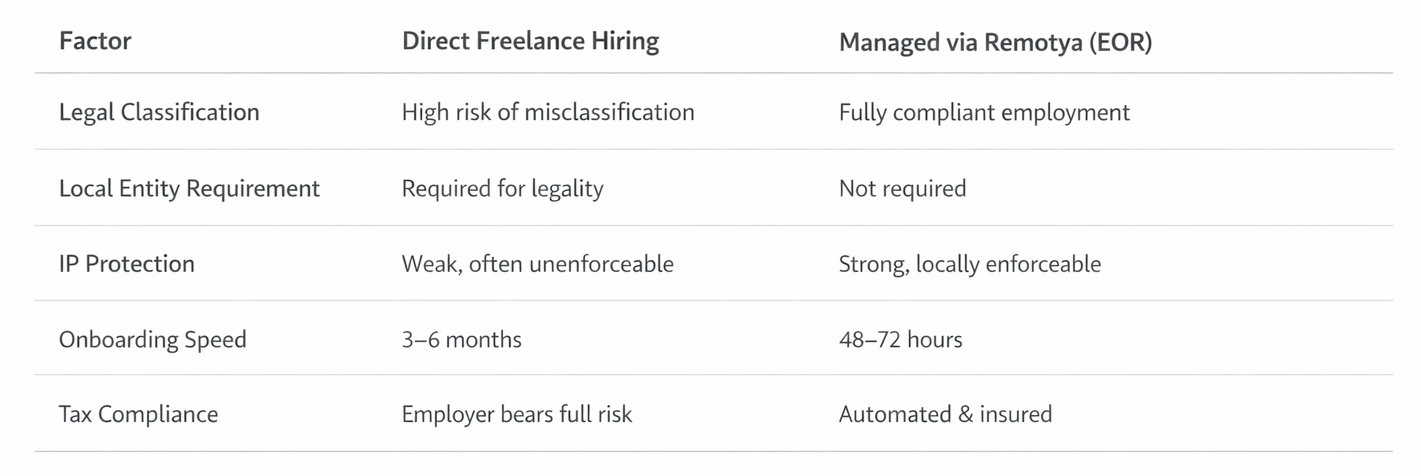
When companies hire directly in Turkey or Syria, they assume full legal exposure—from misclassification risks to unenforceable IP agreements.
Remotya’s EOR framework eliminates these liabilities by providing a compliant, locally recognized employment structure.
The contrast below highlights how dramatically the risk profile changes when compliance is managed professionally.
Intellectual Property (IP) Protection Across Borders
In distributed engineering teams, Intellectual Property is the most valuable asset—and the most vulnerable.
Without enforceable contracts and proper data governance, companies risk IP leakage, disputes over ownership, or unauthorized reuse of code.
Securing Your Assets: Enforceable Contracts in Distributed Environments
For a contract to be enforceable in Istanbul or Damascus, it must be:
Translated
Notarized
Aligned with local civil codes
Explicit about ownership and transfer of rights
Remotya ensures that Work‑for‑Hire clauses are recognized under local law, creating a clean chain of title for all digital assets.
Data Privacy Standards: Aligning Local Operations with Global Requirements
Compliance extends beyond labor laws into data governance. As companies adopt Remote Help Desk MENA solutions, they must ensure that local operations align with global standards like:
GDPR
KVKK (Turkey’s data protection law)
Remotya integrates Proactive Tech Support protocols into the compliance stack—device encryption, access control, secure authentication, and continuous monitoring—ensuring that remote teams operate within a secure, compliant environment.
Infographic: Layers of Remote Data & IP Protection
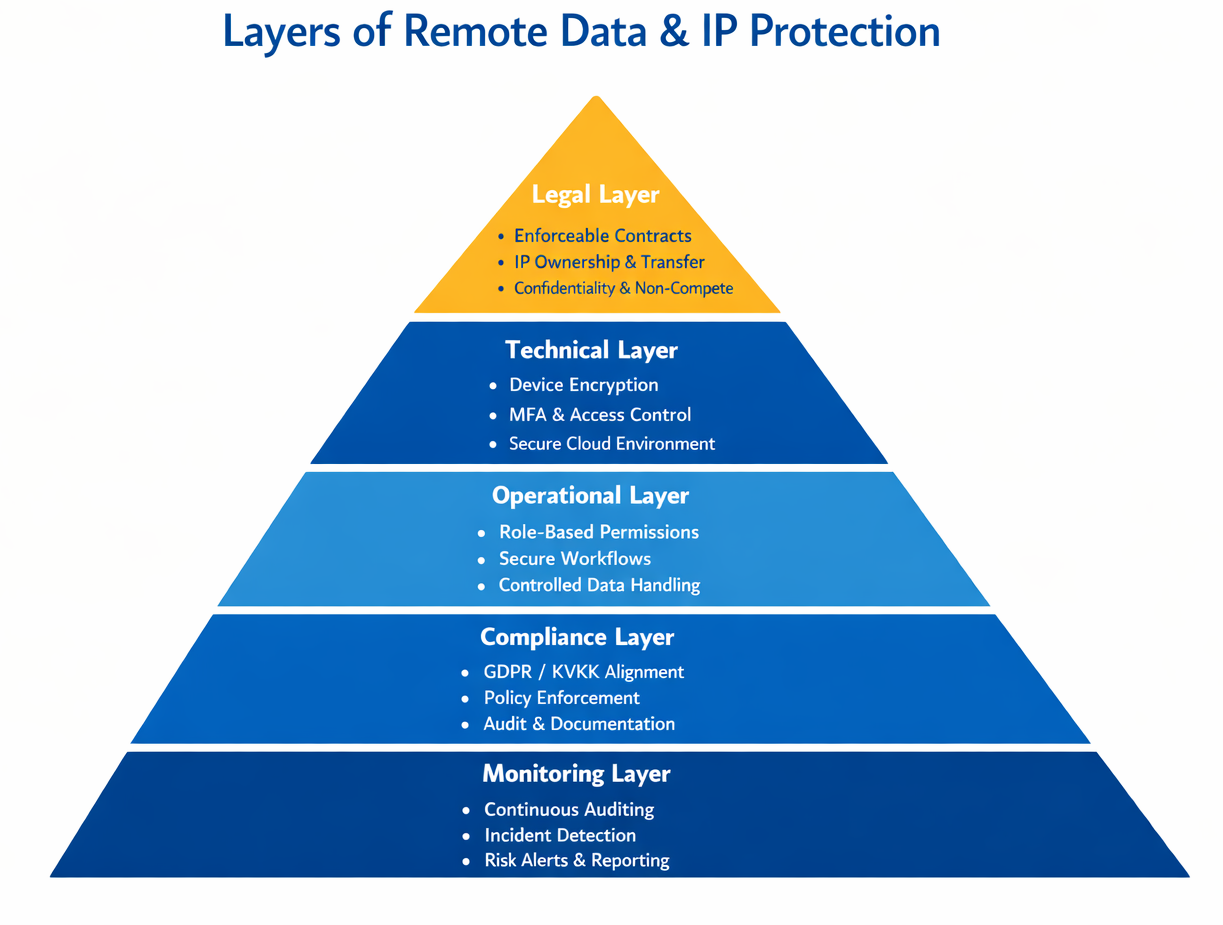
Remote data security isn’t one‑dimensional. It operates across multiple layers that reinforce one another — legal, technical, operational, compliance, and monitoring.
The infographic below visualizes how these layers interact to create a resilient protection framework for distributed teams.
Strategic Mitigation: How Remotya Absorbs Regulatory Friction
Compliance is not just about avoiding penalties; it’s about removing operational noise so your team can focus on building, shipping, and scaling.
Local Expertise: Why “Feet on the Ground” Matters
Algorithms cannot interpret a sudden change in Syrian labor law or navigate a Turkish tax office.
Local presence matters.
Remotya’s regional teams provide real‑time intelligence, anticipating regulatory shifts and ensuring uninterrupted System Availability—the legal equivalent of predictive maintenance.
Automated Compliance Monitoring: Keeping Pace with Changing Regulations
Using Predictive Analytics, Remotya tracks legislative updates across the region.
Employment terms, payroll calculations, and statutory benefits adjust automatically, reducing Remote IT Downtime not only in your systems but in your compliance posture as well.
The Remotya Compliance & Legal Shield Process
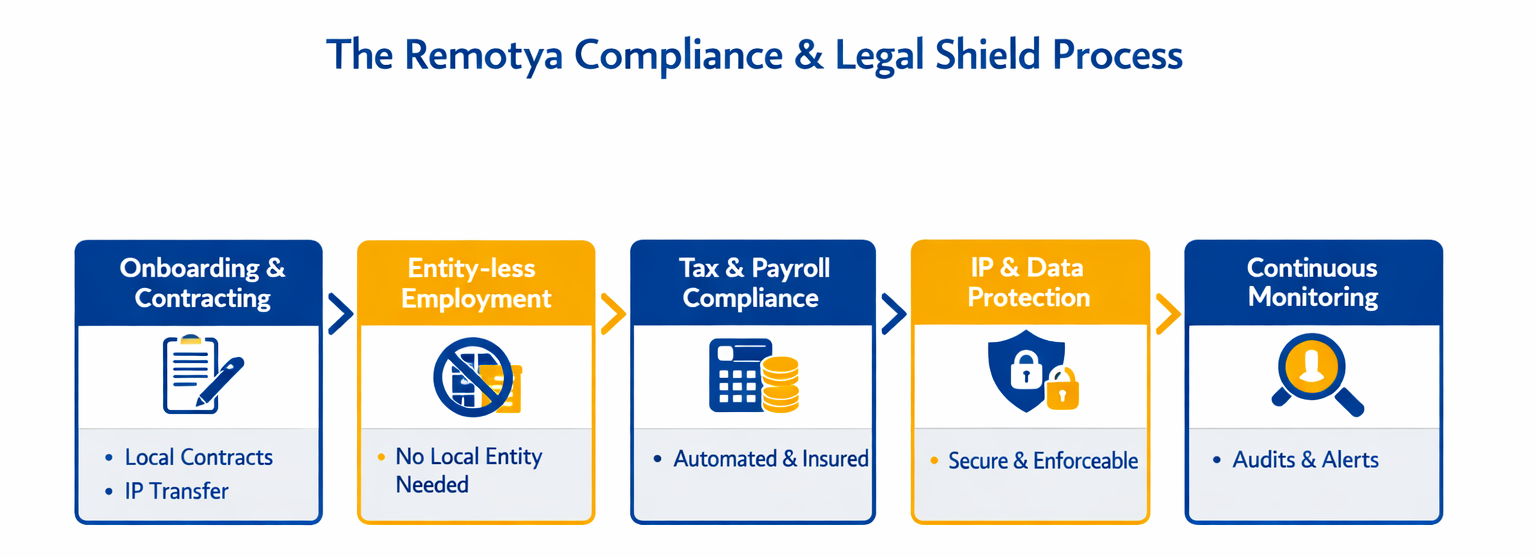
Remotya’s compliance framework operates as a legal shield for global companies expanding into Syria and the Gulf.
The flowchart below visualizes how each stage — from onboarding to continuous compliance — ensures full legal protection and operational transparency.
Moving from Risk to Opportunity: Scaling with Confidence
The companies that win in the Middle East are not the ones that avoid risk—they’re the ones that manage it intelligently.
A compliant, audit‑ready infrastructure unlocks:
Faster hiring
Stronger retention
Access to top regional talent
Confidence in long‑term scalability
Regulatory friction becomes a competitive advantage when your competitors are still stuck in the Ambiguity Effect.
Building a Sustainable, Audit‑Ready Remote Infrastructure
An audit‑ready operation includes:
Locally compliant contracts
Accurate payroll records
Secure data governance
Documented processes
Predictive compliance monitoring
This is the foundation of sustainable remote expansion.
FAQ
How does Remotya handle changes in local labor laws overnight?
Through a redundancy system combining local legal experts with automated payroll updates, ensuring zero MTTR for compliance issues.
Is it legal to hire in Syria and Turkey without a local registered office?
Yes. Through the EOR model, Remotya acts as the legal employer, ensuring full compliance.
How do we ensure IP protection for our software?
Through tripartite agreements that create a clear, enforceable chain of ownership.
What statutory benefits are mandatory in the MENA region?
Typically: social security, health insurance, paid leave, and end‑of‑service indemnities.
What happens if a remote worker disputes their contract?
Remotya manages mediation and legal representation, shielding your international HQ.
Turn Compliance Certainty Into a Strategic Advantage
Legal ambiguity shouldn’t prevent you from accessing world‑class talent.
In a region where Business Continuity and System Availability define operational success,
Remotya provides the intelligence, infrastructure, and legal shield you need to scale with confidence.
Get your Compliance Readiness Audit today—and secure your Middle East operations before the next regulatory shift.