
Remote employee hosting
A Damascus desk that stays online when the grid does not
Home working in Syria fails on power and on the connection, not on the person. Remotya puts the team in a managed office and employs them under its Syrian entity in Damascus. You direct the work. We run the building.
Employed by us, sitting in our office
Hosting is not a lease with a logo on the door. People in the office are legally employed under Remotya's Syrian entity in Damascus. You direct their work.
We run payroll, the contract, the workspace, and the IT around that desk. Buying your own generator, your own fiber, and a local landlord is the path we recommend you skip.
Where a good hire still misses the week
The person is rarely the failure. The room they sit in is.
Power and the connection
Outages and unstable lines miss delivery dates your client already has. The office is built around backup power and a dedicated fiber line so the day does not depend on the home grid.
Hardware managed from another country
Laptops, desks, and repairs coordinated from Riyadh or Dubai eat a founder's week. We buy, maintain, and replace on the ground in Syria.
A home that cannot hold a workday
Cuts, drops, and a noisy room show up as missed output. A staffed office is the control we recommend over hoping the apartment holds.
What is in the office
Power that does not trust the grid
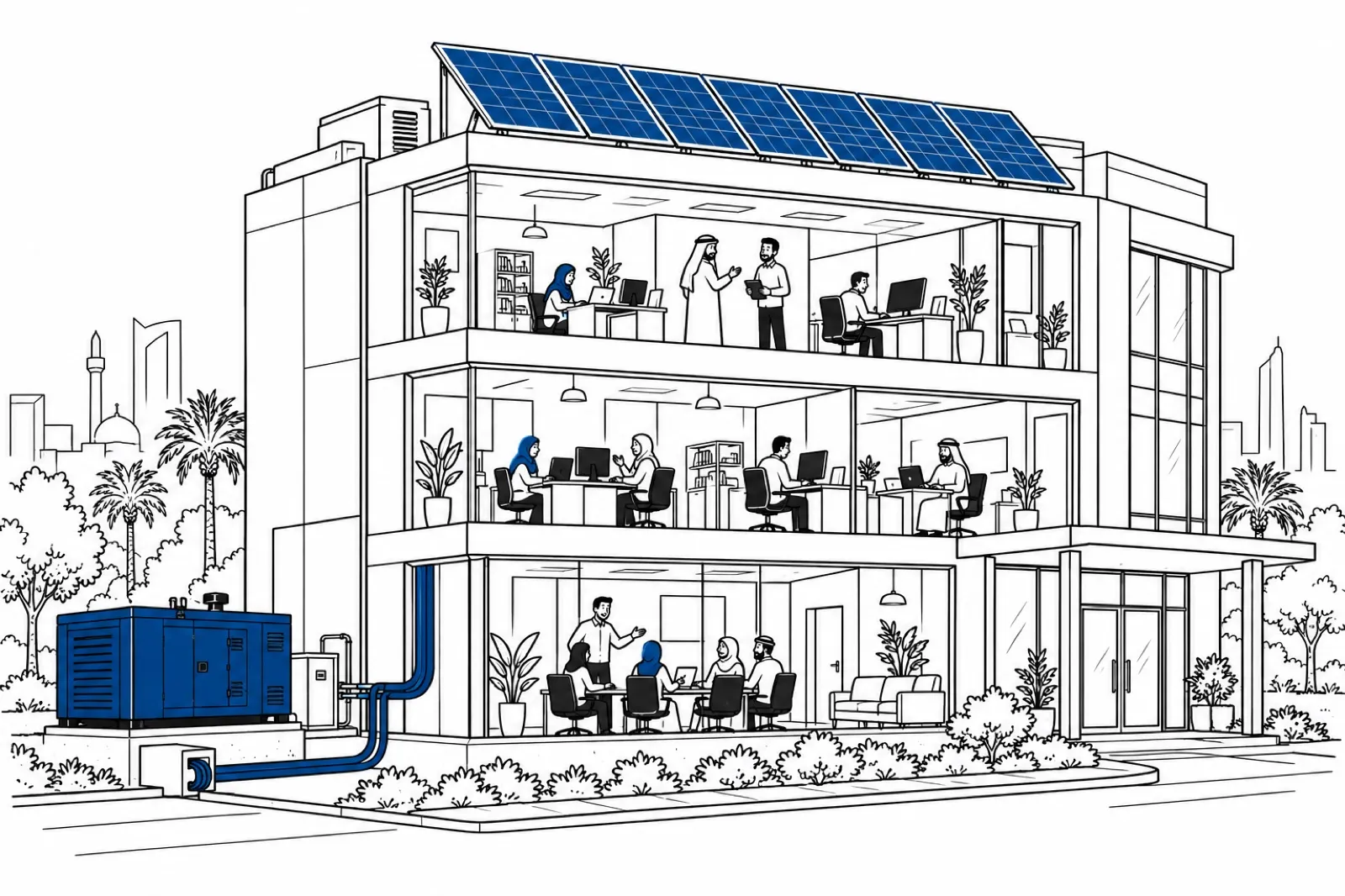
Solar, backup generators, and voltage-regulated power, plus a dedicated fiber line. The workday is built on that kit, not on a home grid.
Rooms built for a workday
Desks and meeting rooms, set up for focus and for a call with your headquarters. The point is a professional room, not a residential workaround.
Hardware on site
Procurement, maintenance, and a secure place for the machines. You do not ship a laptop into Syria and hope.
People on the floor, every day
Security, utilities, maintenance, and logistics sit with on-site leads. Leadership should hear about an exception, not about a blown breaker.
Cost against a GCC hire, and who stays
Why a managed office, not a home allowance
One operator for the room and the employment
Physical space, power, connectivity, and the Syrian employer of record sit together. You should not contract those separately and then reconcile them.
Operating cost, not a fit-out project
You expand without buying desks, generators, or a local infrastructure project. The spend follows the team.
A reason to stay
A stable room is why people stay. 89% are still employed at 12 months.
Clients, as the work actually was
Soit Belle, a UAE jewelry brand
Shift teams and customers on the floor, where presentation is the product. Remotya's work was the HR structure: discipline and performance held to that brand standard.
Plan A, hiring plus the base under it
A growing tech company needed more than the next vacancy. Remotya supported hiring and the people and operations base required to absorb those hires.
Four steps, and the on-site lead stays
Map headcount, machines, and access
How many people, what they run, and who is allowed in the room. The design follows that, not a standard floor plan.
Prepare the room
Desks, dedicated fiber, and power: solar, generators, and voltage regulation. Hardware is in place before move-in day.
The team moves in
On-site leads take the daily floor: access, utilities, and the small failures that stop a shift.
We do not hand you a key and leave
After go-live, Remotya stays on the building, the power, and the employment. Continuity is the service. A setup week is not.
Labour law, access, and the machines
People on our payroll in the office are under Syrian labour law, employed by the Damascus entity. GCC employment norms still apply to a GCC client, and we write that down.
The practical control is the room: badge access, a known network, and power that does not depend on a home grid. Data sits on managed machines. Remotya operates by Islamic business principles.
Questions about hiring into a Syrian office
Why use a managed office for talent in Syria?
Because the infrastructure decides whether the hire delivers. The office provides stable power, fiber, and a controlled room. Home setups in Syria do not.
Is a remote team in Syria secure?
More secure than a residential network. We run professional facilities with secure networks, someone on site, and access rules. A home router is the weaker option, and we will say that plainly.
What keeps the office online?
Solar, backup generators, voltage-regulated power, and a dedicated fiber line, watched on site. That is redundancy against a bad grid. It is not a contractual promise that nothing will ever drop.
Why not let people work from home?
Work from home in Syria is unpredictable: power cuts, connection drops, and a room that is not a workplace. We recommend the office when the client needs the week to happen on schedule.
The hosting notes, then the IT desk
Compliance and the logistics of employee hosting are in Employee hosting, compliance and logistics. What a managed office returns compared with the alternatives is in Managed office spaces and ROI.
Machines, networks, and device control are on managed IT operations.
Tell us how many desks, and where the client sits
Bring the headcount and the city your headquarters is in. We will say what the Damascus office needs to hold, and what employment under our entity would cover.