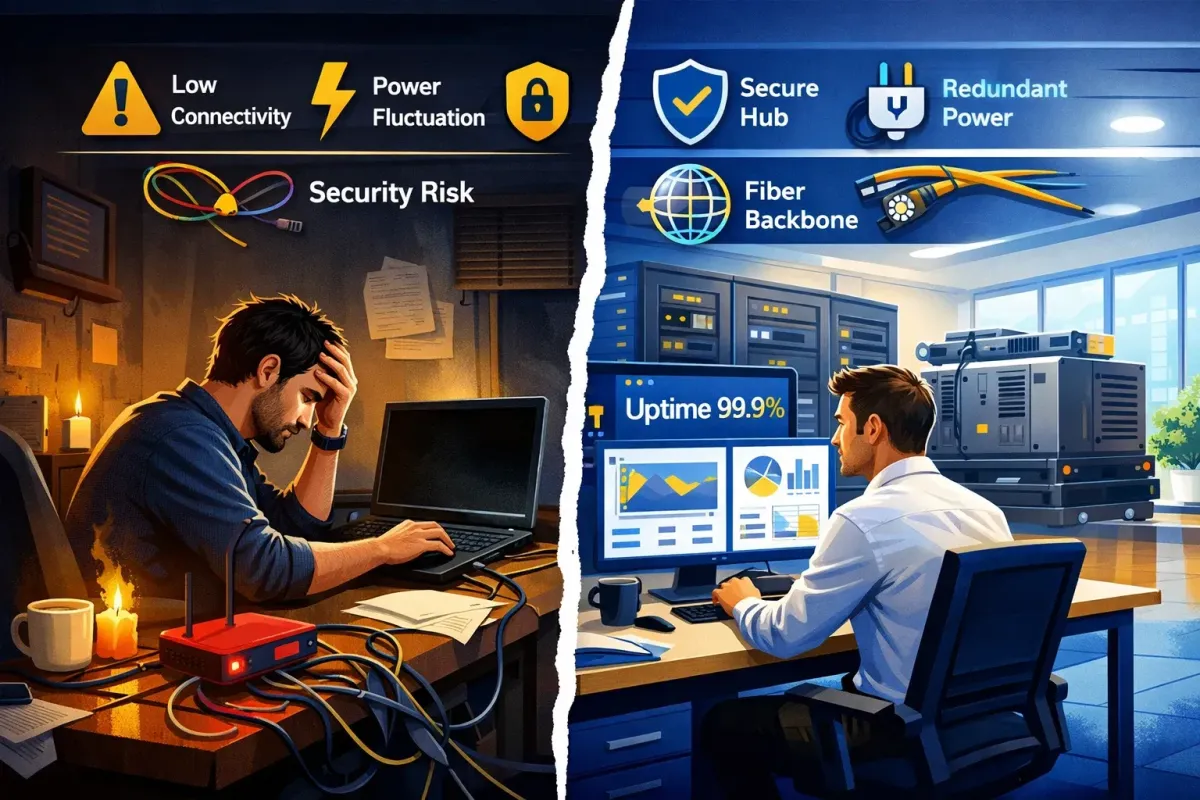
Remote Team Management: Scaling Beyond the Home Office Model
The honeymoon period of remote work is officially over, giving way to a period of rigorous operational accountability.
In the initial surge of the digital shift, the success of Remote Team Management was measured by how well a company utilized cloud-based communication tools like Slack or project management platforms like Jira.
However, as the model matures and organizations attempt to scale, a stark reality has emerged: exceptional leadership and agile frameworks cannot compensate for failing infrastructure.
The core issue is that most organizations treated the "Home Office" as a scalable, long-term virtual environment. In reality, over-reliance on residential setups has become a "Scalability Trap."
This trap does not just hinder productivity; it erodes Business Continuity and makes a company’s output a hostage to logistical variables beyond its control.
The Scalability Trap: Why "Soft Management" Isn’t Enough
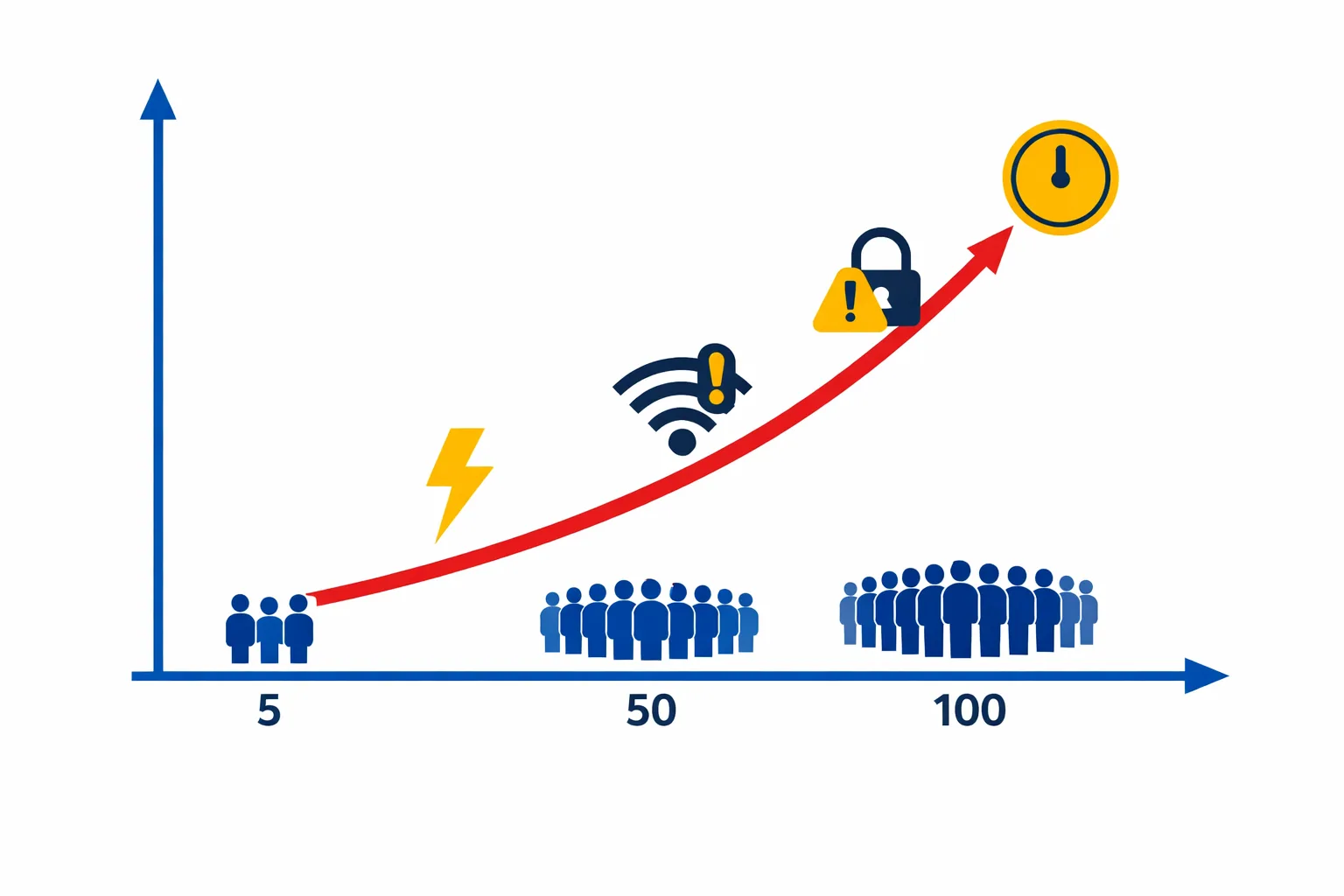
When your team consists of five people, you can manage a sudden internet outage or power fluctuation by simply rescheduling a task.
However, as a team scales to 50 or 100 employees across diverse geographies, these "minor glitches" transform into a severe operational hemorrhage.
Most current Remote Team Management frameworks focus heavily on "Soft Skills"—digital culture, transparency, and trust.
While these elements are vital, they remain powerless against the "Infrastructure Reliability Gap." A talented developer who loses connection during a critical deployment, or a manager who vanishes from a board meeting due to local ISP failure, represents a direct hit to Technical ROI.
At this stage, the bottleneck is no longer managerial; it is the absence of enterprise-grade Physical Infrastructure.
The Physical Layer: The Forgotten Backbone of Remote Work
The operational gap becomes glaringly obvious when companies demand "Headquarters-level" performance from employees working in residential environments that were never designed for enterprise reliability.
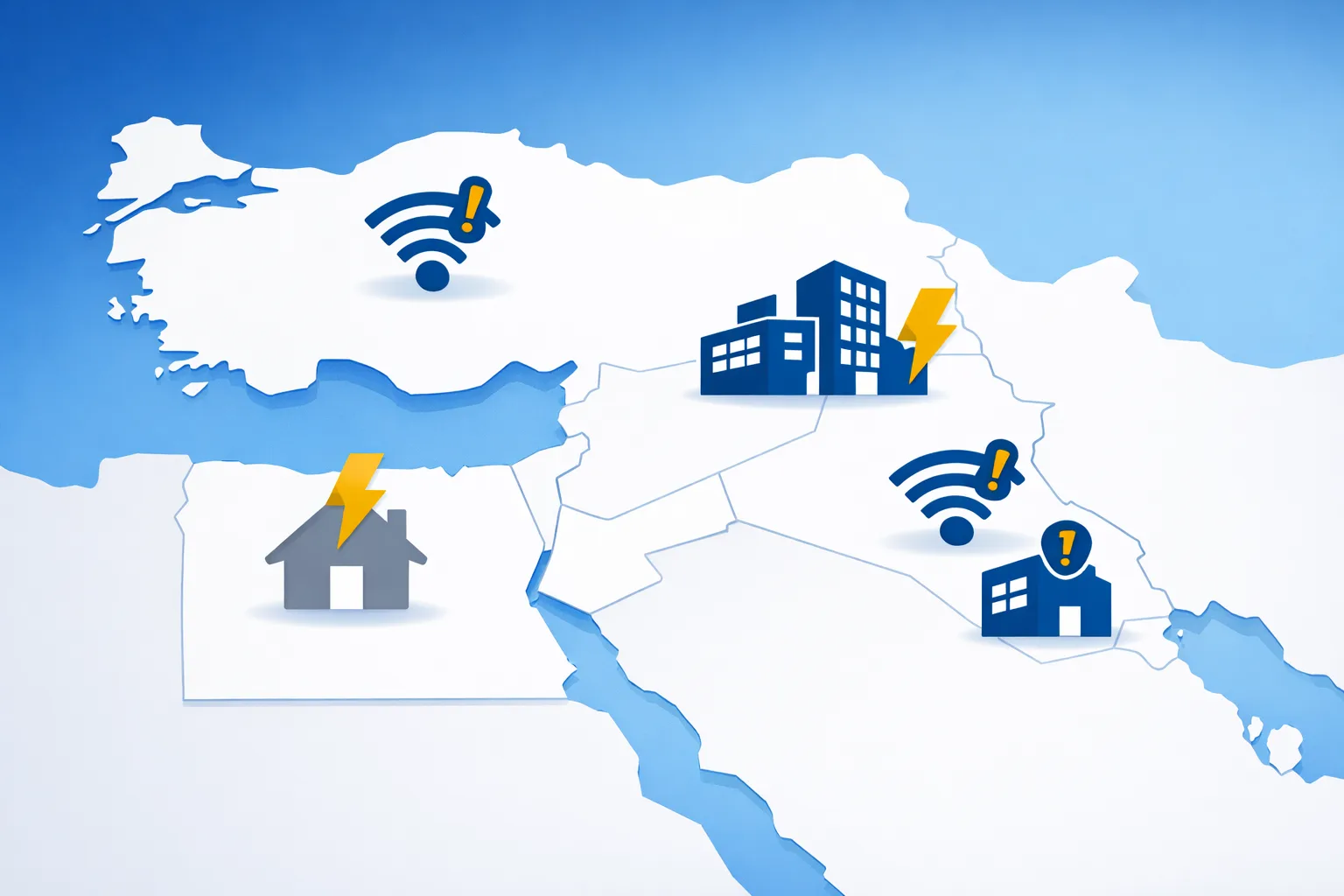
Particularly in the MENA region, managers face challenges that simply do not exist in global management handbooks:
Utility Volatility: In emerging markets, relying on residential power and internet is a gamble. Critical operations cannot afford a one-minute blackout, let alone hours of "load shedding."
Security & Data Privacy: A home environment lacks the rigid physical and technical security perimeters required for sensitive data protection, leaving the company vulnerable to breaches through unsecured networks.
Cultural & Professional Erosion: Long-term isolation, compounded by the frustration of constant technical hurdles, leads to a decline in Employee Retention. Top talent requires an environment that fosters institutional belonging, not just a desk in a bedroom.
Moving from "Task Management" to "Operational Continuity Management" requires acknowledging that the Digital Layer cannot succeed without a solid Physical Layer to support it.
The Operational Maturity Framework
To scale beyond the limited home office model, organizations must evaluate their remote operations maturity across three distinct stages:
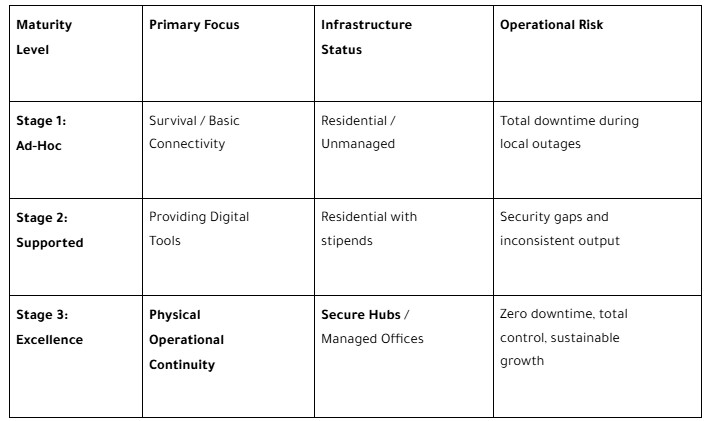
Reaching Stage 3 is what differentiates companies that merely "survive" the remote model from those that lead the market through it.
Regional Logistics: Managing Presence in Volatile Markets
In markets like Egypt, Turkey, Jordan, or Syria, Business Continuity is not just a buzzword—it is a daily logistical struggle.
Global companies scaling in these regions quickly discover that finding talent is the easy part; maintaining their Operational Presence is the true challenge.
A strategic Remote Team Management perspective recognizes that "anchoring" a high-value employee in a volatile residential setup is a waste of human capital.
This is where the concept of the Hosted Operational Hub comes in. These hubs do not just provide desks; they provide an "operationally insulated" environment.
With industrial-grade power backups, redundant fiber connections, and security protocols that mirror Silicon Valley standards, these hubs ensure the team remains online regardless of regional utility failures.
The Link Between Infrastructure and Employee Retention
There is a direct correlation between workspace stability and long-term retention. In a home-office-only model, employees often face the "stress of proving presence" despite failures beyond their control. This constant friction leads to rapid burnout.
By establishing a physical Operational Presence, a company provides its talent with a "Professional Anchor."
This signals a deep investment in the employee’s success, offering them the tools to perform at their highest level without domestic distractions. The result is a significant decrease in turnover and an increase in the "Return on Talent."
Scaling Through Operational Presence
Scalability requires speed. If a company must build its own office in every city it hires in, it will drown in Regional Logistics and local bureaucracy.
The Managed Office Spaces model solves this by offering "Operations as a Service." A company can hire 20 engineers in Cairo or Istanbul and move them into a Secure Hub immediately—without managing leases, utility contracts, or hardware maintenance. This is the true definition of frictionless scaling.
Strategic FAQ for Remote Leaders
Q: Does physical infrastructure undermine remote flexibility?
A: On the contrary, it empowers it. It provides a "stability option" for critical sprints and deep work, ensuring that the team’s flexibility is not limited by their home’s infrastructure.
Q: Why not just provide stipends for better home setups?
A: Because individual solutions do not provide "Institutional Reliability." Residential nodes are still tied to a weak public grid. Only a managed, centralized infrastructure can guarantee the uptime and security required for enterprise growth.
Q: How do managed hubs solve Regional Logistics?
A: By acting as the local operational partner. Remotya, for example, handles the entire physical stack—from hardware procurement to 24/7 power redundancy—allowing the client to focus exclusively on team management.
Conclusion: Investing in Operational Certainty
Scaling a distributed team is not just about the number of daily stand-ups you hold; it’s about the strength of the physical foundation your employees stand on.
Investing in Managed Office Spaces is not an additional real estate cost—it is an investment in "Operational Certainty."
In a volatile economic climate, companies cannot afford lost time. If your remote team’s productivity is inconsistent despite having top-tier talent, it is time to look beyond the screen and examine the infrastructure.
Scaling beyond the home office is the first step toward building a global organization that is truly resilient.
Ready to see how infrastructure stability translates into financial ROI?