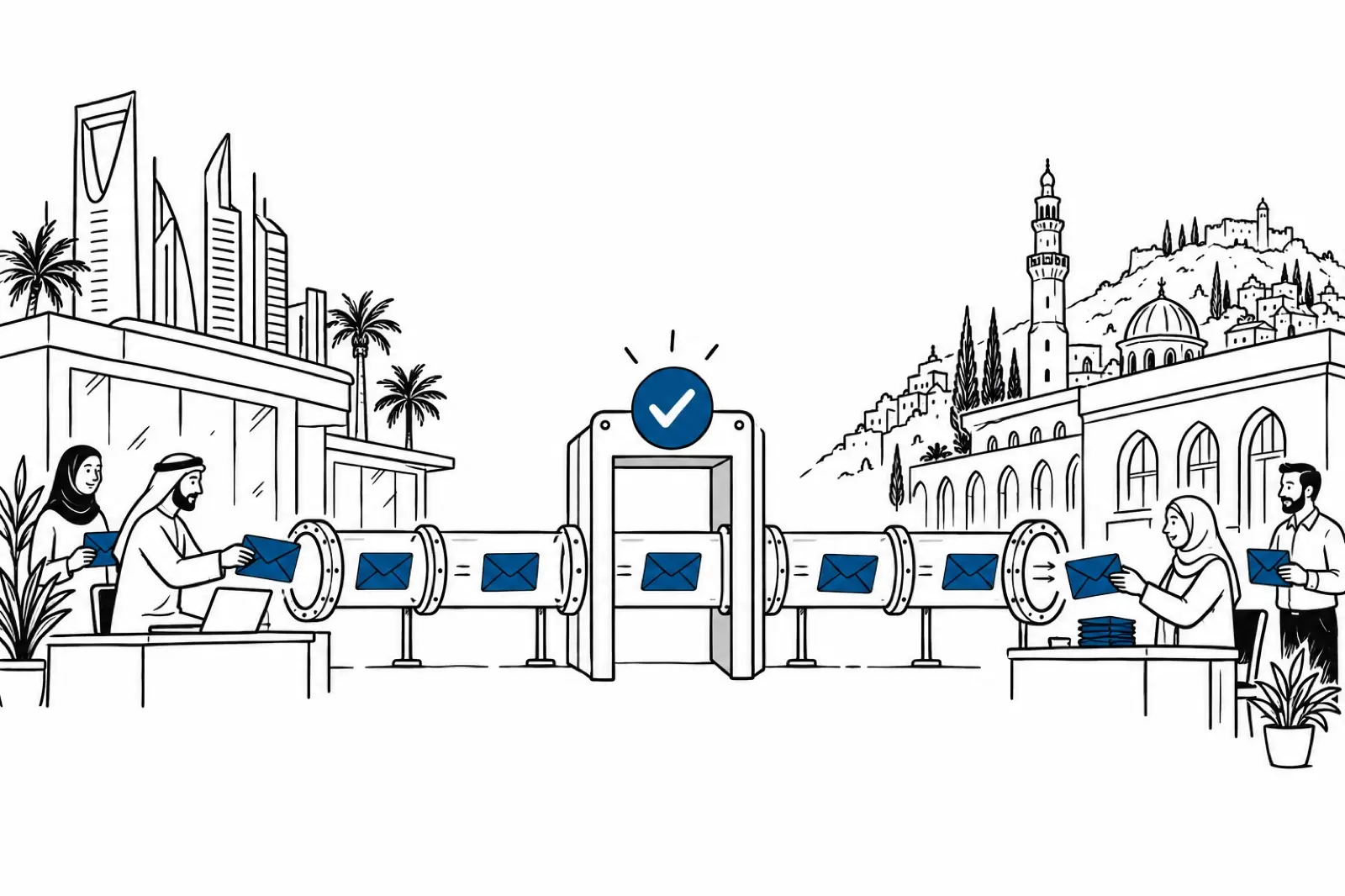

Can you hire employees in Syria in 2025, or do the old sanctions still block the contract? The Syria Sanctions Program ended on 1 July 2025, and the hire still has to sit with a local employer.
OFAC FAQ 1220 is the page that retired the 2023 answer. Executive Order 14312 removes sanctions on Syria effective 1 July 2025. As of that date the Syria Sanctions Program is no longer in effect, and persons blocked only under the revoked orders were removed from the SDN list. For anyone hiring into Syria in 2025, that paragraph is the change. It is not permission to pay any person, by any route, because a forwarded note said the war-era rules had vanished.
Remotya’s position is the one we give on a discovery call. The person is employed under our Syrian entity in Damascus. We handle the contract, the payroll, compliance, the workspace and IT. You direct the work. That split is HR services. We will not sketch an informal transfer, and we will not call a personal favour a salary. Once the employment is real, the wage itself is a payroll question, covered in how a Gulf company pays a salary inside Syria.
The Syria Sanctions Program ended on 1 July 2025
Put the date above anyone’s summary of it. Effective 1 July 2025, Executive Order 14312 took the Syria Sanctions Program out of effect. People blocked only because of the orders this action revoked came off the SDN list. People blocked on some other basis were not waved through by that sentence.
For a hiring manager in Riyadh, the stale brief is the one that still says Syria is sanctioned as a country, full stop. That was the country program. FAQ 1220 says the program is no longer in effect. A memo dated 2023 can go in the drawer.
Retiring the memo does not hire the person. It does not file social insurance in Syria. It does not put a checked laptop on a desk in Damascus, and it does not make a bank’s compliance team change its mind. Ending a country program removes one barrier that used to stop many contracts and many payments with a U.S. nexus. A Saudi company with no U.S. person on the org chart can still meet that nexus at the bank, at a processor, or through an American customer. Know the rule when you think it is not yours.
Skip the second half of that FAQ and you will tell the board that sanctions are over, then fail a name screen in week two. Removal from the SDN list covers persons blocked only under the revoked orders. It does not clear every Syrian national, and it does not clear a 2024 vendor because the country heading changed.
Amended E.O. 13894 can still list people
The same FAQ keeps a power the headlines bury. The order keeps and expands the ability to sanction Bashar al-Assad, his associates, human rights abusers, captagon traffickers and other destabilizing actors under amended E.O. 13894.
The country program ended. The ability to list specific people did not shrink. The FAQ’s verb is expands.
A software engineer in Damascus is not sanctioned for living in Damascus. Screen the person, the vendor and the bank against those categories. If your only question is whether the country program is still on, you are screening the wrong object.
FAQ 1220 is precise about who left the SDN list: persons blocked only under the revoked orders. “Only” carries the sentence. A person listed on another basis can remain listed. Counsel or a proper screening tool checks the individual, name by name, before the contract is signed.
Informal routes are the wrong answer to a list you hope is empty. Paying the wage through a personal arrangement outside the employment contract does not become acceptable because the country program ended. It takes the payment off the file you would need if a counterparty later turned out to be listed. Remotya will not arrange that, and this post will not describe how such an arrangement works. Employment sits on our Syrian entity. Payroll is part of that employment. You still manage the tasks, the reviews and the roadmap.
General License 25 authorized financial services to Syria
Treasury’s relief notice is the third document, and it is the one people over-read. General License 25 authorized transactions prohibited by the Syrian Sanctions Regulations, including new investment and the provision of financial and other services to Syria. FinCEN gave exceptive relief so U.S. banks could keep correspondent accounts for the Commercial Bank of Syria.
A salary paid as a formal service sits next to that sentence. A hidden cash path does not. The bank sentence is narrower than the license. The exceptive relief lets U.S. banks keep correspondent accounts for the Commercial Bank of Syria. It names that bank. It does not say every Gulf retail bank will credit any personal account in Damascus on a date you pick. If your finance lead says their bank still refuses the transfer, that report can be true while the FAQ stays true. The next step is a formal channel the employer can document. Not a side door.
Remotya’s channel is local payroll under the Syrian entity. On our own run, payroll accuracy is 99.5%. You do not incorporate in Syria to get there. Time-to-hire on the approved profile is 10 to 21 days. Those figures describe the operation. They are not a legal opinion on your bank. We do not publish a price. Terms come after a discovery call.
One limit, so the license is not asked to do work it does not do. General License 25 does not clear a person who remains sanctionable under amended E.O. 13894. Screen first. Then sign the local contract. New investment being authorized is a country-level statement. It is not a character reference for the individual you want to hire on Monday.
Two more barriers fell after July 2025
The 1 July 2025 order was the first step, not the last. Two later changes matter to a Gulf employer.
On 18 December 2025 the President signed legislation repealing the Caesar Act. OFAC describes the effect as removing the threat of mandatory Caesar Act sanctions on foreign persons providing support to the Government of Syria. That was the secondary-sanctions risk Saudi boards remembered best.
On 24 August 2026 the State Department removed Syria’s designation as a State Sponsor of Terrorism. OFAC’s notice that day says Syria is no longer subject to the Terrorism List Governments Sanctions Regulations.
Neither change touched amended E.O. 13894. Assad, his associates, human rights abusers and captagon traffickers can still be listed, and the Department of Commerce still controls the export of certain items to Syria. The name screen in the next section stays on the checklist.
A local employer is how you pay without a side path
The compliant route is dull. That is the point. Remotya’s Syrian entity is the employer on the contract. The contract is written to Syrian labour law, not a foreign template with the city name swapped. Payroll runs in Syria. You direct the work. We stay on the file after the first month. Compliance that ends at go-live is a launch checklist, not a system. We also operate by Islamic business principles, which rules out a hidden payment path when a bank is slow.
Four checks, in this order.
The employer on the contract has to be real
If the person invoices your Saudi company as a freelancer, you do not have Syrian employment. You have a contractor file sitting beside a sanctions question you have not finished. Remotya puts its Syrian entity on the contract. You keep direction of the work.
The wage has to be payroll
Agree the currency, the method and the date, and pay it as payroll. Do not ask the employee to collect the wage outside the country because a transfer might fail. The relief notice pointed at formal financial services, including correspondent accounts for the Commercial Bank of Syria. Use a formal path. The operational version of that point is paying a salary inside Syria.
Screen the names before you sign
Amended E.O. 13894 can still reach Bashar al-Assad, his associates, human rights abusers, captagon traffickers and other destabilizing actors. Your counsel or a screening tool checks the actual names. Run that check before you sign, not after.
The file stays open after month one
Remotya stays on payroll, the contract and the workspace. If the formal route is slow, fix the route with the bank or with the local employer. Do not hide the wage. Hiding it is the habit the 1 July 2025 change was supposed to make unnecessary, and it is a habit we will not help you build.
A Damascus hire does not settle Nitaqat
Some founders open a sanctions page when the real worry is Saudization. Staff employed in Syria are not a Qiwa contract, and the end of the Syria Sanctions Program did not turn them into one. Nitaqat reads documented Saudi contracts. That decision is separate, and it is written up in Nitaqat and staff outside Saudi Arabia.
Keep the two files apart. A clear reading of FAQ 1220 does not raise your Saudi band. A team in Damascus does not fix a visa renewal in the Kingdom. It also does not belong in the denominator you show the ministry.
This is general information, not legal advice.
Book a discovery call if you want the person employed under a Syrian entity, with the contract and the payroll handled, while you direct the work. We will say what the entity covers. We will not draw a sanctions bypass.
Sources
- OFAC, Syria sanctions FAQs, including FAQ 1220
- U.S. Treasury press release on Syria sanctions relief
- OFAC recent action, 24 August 2026: Syria removed as a State Sponsor of Terrorism
Questions readers ask
Can a GCC company hire employees in Syria in 2025?
The Syria Sanctions Program ended on 1 July 2025 under Executive Order 14312. You still need a local employer, a contract and a formal payroll. Remotya employs through its Syrian entity. You direct the work.
Did every name leave the SDN list?
No. OFAC FAQ 1220 says persons blocked only under the revoked orders were removed. Amended E.O. 13894 still allows sanctions on Bashar al-Assad, his associates, human rights abusers, captagon traffickers and other destabilizing actors.
Does General License 25 force my bank to send salaries?
General License 25 authorized transactions the Syrian Sanctions Regulations had prohibited, including new investment and financial and other services to Syria. FinCEN let U.S. banks keep correspondent accounts for the Commercial Bank of Syria. That is not an order to your own bank, and it is not a reason to use an informal transfer.
Can I pay a Damascus hire through someone outside Syria?
No. Remotya does not arrange informal transfers. The compliant route is local employment and payroll under a Syrian entity, with you directing the work.
Is the Caesar Act still a risk for a Saudi company hiring in Syria?
The Caesar Act was repealed on 18 December 2025, which removed the threat of mandatory Caesar sanctions. On 24 August 2026 Syria's State Sponsor of Terrorism designation was rescinded. Name screening under amended E.O. 13894 still applies.
Does this post replace legal advice?
No. This is general information, not legal advice. Your counsel, your bank and a name screen still sit on the decision.