
Hiring remote employees in MENA is the easy part. Keeping them compliant, secure and operational is where companies fail.
Between signing the contract and getting consistent output sits what we call the physical gap: legal exposure, power cuts, weak home internet, hardware stuck in customs. Most COOs reach for an Employer of Record first. Then the team scales, and they learn that payroll is only half the battle.
The model growing teams land on is employee hosting: legal employment combined with the physical infrastructure a professional needs to produce reliably.
What employee hosting is
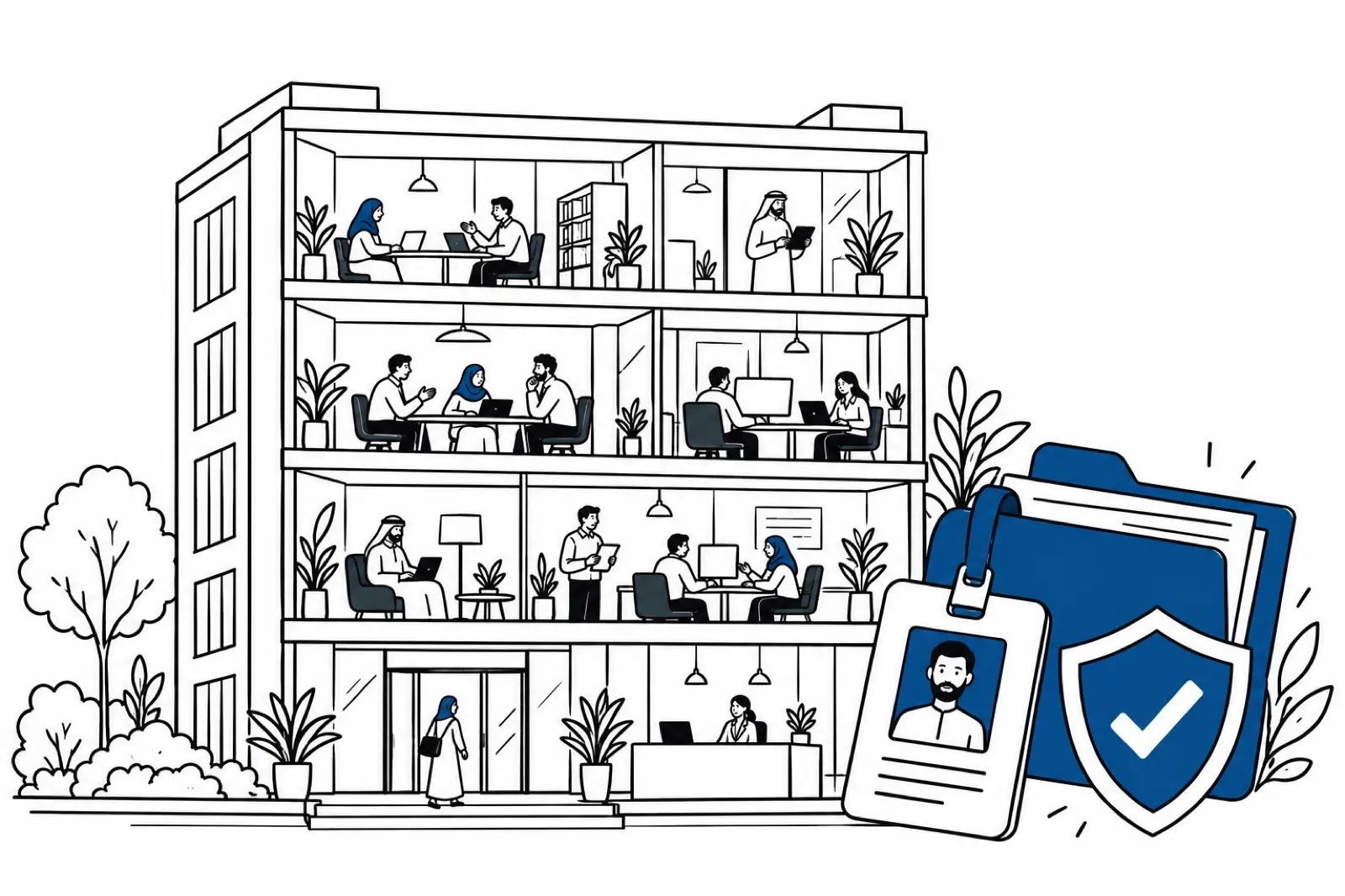
Employee hosting is a managed service that provides a secure physical workspace, enterprise-grade infrastructure and local administrative support for your remote employees. The team works from a controlled environment, not from spare bedrooms, while remaining fully remote from your perspective. They report to you, join your standups and work your roadmap.
The split is this: an EOR is the legal layer (contracts, taxes, payroll). Hosting is the operational layer (the desk, the electricity, the secure internet, the day-to-day compliance).
EOR solves payroll, hosting solves everything after payroll
An EOR answers “how do we pay someone in Egypt or Turkey?” It does not care when your employee loses power for six hours. It does not care that the residential router just got compromised.
Hosting closes that gap. It creates a legal and operational buffer between your company and regional infrastructure instability, while keeping you aligned with local labor standards. If you want the legal layer explained on its own, read what an Employer of Record actually does.
One more distinction matters. Compliance for a remote workforce is not only about paying taxes correctly. It is about meeting the professional standards your own clients expect from anyone touching their data and their deadlines.
Three problems a hosted workspace removes
Power and internet stop reaching your sprint
In much of MENA, outages and slow connections are daily events, not rare accidents. The lost hours hide inside “infrastructure friction”: the meeting that restarted twice, the deploy that waited for the generator. A hosted facility carries industrial-grade backup power and fiber redundancy, so a utility failure in the neighborhood never reaches your deployment cycle.
The security perimeter gets physical walls
In a home office you control nothing: who enters the room, what else sits on the Wi-Fi, where the laptop sleeps. A hosted hub gives you an auditable environment with card-access entry, dedicated hardware storage and isolated networks. For fintech, medtech and govtech work, clients increasingly demand exactly this, and the audit question arrives sooner than most founders expect.
Regional logistics stop eating your week
Hardware shipping, customs clearance, local maintenance, workspace standards. Managing that per employee is an administrative drain on your HR and IT leads, and it scales linearly with headcount. Five remote employees means five small logistics operations running in parallel.
With hosting, a new hire walks into a fully equipped desk in days, not months. One vendor handles the machine, the connection and the maintenance ticket. This is the core of our remote employee hosting service.
Compliance goes past the written contract
Many MENA jurisdictions have de facto requirements that never appear in the labor law text. Technical teams face real scrutiny over physical presence and working conditions.
A professional facility answers that scrutiny. It also does something less obvious: it retains people. Senior professionals stay longer with companies that invest in their working environment, a workspace that feels like a corporate HQ rather than a kitchen table. We call it a professional anchor.
The alternative has a name too: operational drift. Isolated remote staff with poor tools slowly lose consistency, then motivation, then their notice period. The numbers behind the workspace trade-off are in our breakdown of managed office ROI for remote teams.
Four signs you need hosting now
Not every company needs hosting on day one. You do when any of these are true:
- Your team reports frequent outages. Internet drops or blackouts are disrupting meetings and deploys.
- Clients require audited security. You handle sensitive data and your contracts demand physical security standards.
- You have more than five people in one country. Coordinating home logistics for a cluster becomes a part-time job nobody was hired for, and it grows with every offer letter.
- Speed matters. You need an operational presence in a market like Egypt or Turkey without the multi-month delay of opening a local office.
A stipend is not a strategy
The usual counterargument is the home-office stipend. It looks cheaper on a spreadsheet. It is not, once you price in what it buys: no control over the workspace, no answer when the power grid fails, no audit trail when a client asks how their data is protected. A stipend transfers the problem to the employee and hopes they solve it.
Hosting treats the environment as part of the hire, funded, owned and managed like any other production dependency. That is the difference between a team that works remotely and a team you can actually run.
If your remote team is losing hours to infrastructure rather than performance, the environment is the problem. Book a discovery call and we will tell you directly whether hosting fits your case.
Questions readers ask
Is employee hosting more expensive than a remote stipend?
A stipend is a cost; hosting is an investment in output. Once you count the revenue recovered by removing downtime and the cost of replacing churned hires, hosting often pays for itself.
Does hosting replace our EOR provider?
It can. Remotya runs the legal layer (Employer of Record under our Syrian entity) and the operational layer (workspace, power, secure internet) under one roof.
What if our employees prefer working from home?
Most senior professionals in MENA prefer a hybrid pattern. They value home flexibility but rely on the hosted hub for critical work, fast collaboration and the days their home utilities fail.